Back
LMS vs LXP vs Authoring Tool
Most L&D teams aren't buying the wrong tool. They're buying the wrong question.
The categories were built for vendors, not users
Let's be clear LMS, LXP, and authoring tool are useful distinctions. They describe different technical architectures, different commercial models, different use cases.
But here's the problem: your learners don't think in categories. Neither do your admins.
A learner is trying to:
Find what's relevant to them today
Complete it quickly without friction
Prove it happened (for compliance or their manager)
Actually retain something useful
Get back to their real job
An admin is trying to:
Assign training at scale without manually chasing people
Track completion with enough confidence to answer "are we compliant?" in 30 seconds
Update content without breaking historical reporting
Run one report that tells the full story
None of those jobs map neatly to a single category. They cut across all three.
What fragmentation actually costs
Here's what the typical L&D stack looks like for a growing UK SMB in healthcare, non-profits, or education:
An LMS for assignments and compliance tracking
A SharePoint or Google Drive for content storage
An authoring tool (or just PowerPoint) for creation
A spreadsheet for the reporting your LMS can't produce
And someone's inbox holding everything together
This isn't a failing it's what happens when you buy point solutions to solve point problems. But the cumulative cost is invisible until it isn't.
The quiet cost isn't the software spend. It's trust.
When your reporting doesn't match reality, people stop believing the system. When the system isn't believed, it isn't used. When it isn't used, your completion rates stall and the honest answer to "are we compliant?" becomes "we think so."
That's the real risk for compliance-driven organisations. Not the cost of three subscriptions. The liability that comes from not actually knowing.
The question most buyers aren't asking
The default buying question is: "Which tool fits our needs?"
The better question is: "What does our end-to-end learning workflow look like and where does it break?"
Breakage points usually cluster around:
Creation content lives in too many places, updating is manual, version control is nonexistent
Assignment enrolments are still done by hand or via spreadsheet import
Discovery learners can't find what they need without asking someone
Proof completion data is fragmented, reports require assembly
Retention there's no mechanism for reinforcement after a course ends
Most organisations have at least three of these. And most of them are trying to fix it by adding another tool.
Categories optimise vendors. Workflows optimise humans.
This is the reframe that changes how you buy:
Vendors are incentivised to define their category as the most important one. LMS vendors say compliance requires an LMS. LXP vendors say engagement requires experience. Authoring vendors say quality requires dedicated tools.
They're not wrong. But they're also not responsible for whether your team can stitch it all together.
You are.
So instead of asking "Are you LMS or LXP?", ask:
What should feel like one experience for the learner from finding to completing to proving?
What should feel like one system for the admin from assigning to tracking to reporting?
What does your team spend time on that isn't actually L&D work? (That's your fragmentation cost.)
What this means for how you build your stack
The organisations getting this right aren't necessarily buying fewer tools. They're being more deliberate about what they're asking each tool to do and ruthless about eliminating redundancy.
The ones getting it wrong are buying labels and hoping for outcomes.
If your platform requires three logins to do one learner's job, the categories aren't the problem. The workflow is.
And if your team spends more time managing the system than improving learning it's not a training problem. It's a stack problem.
This is what Sodium Learn was built to fix
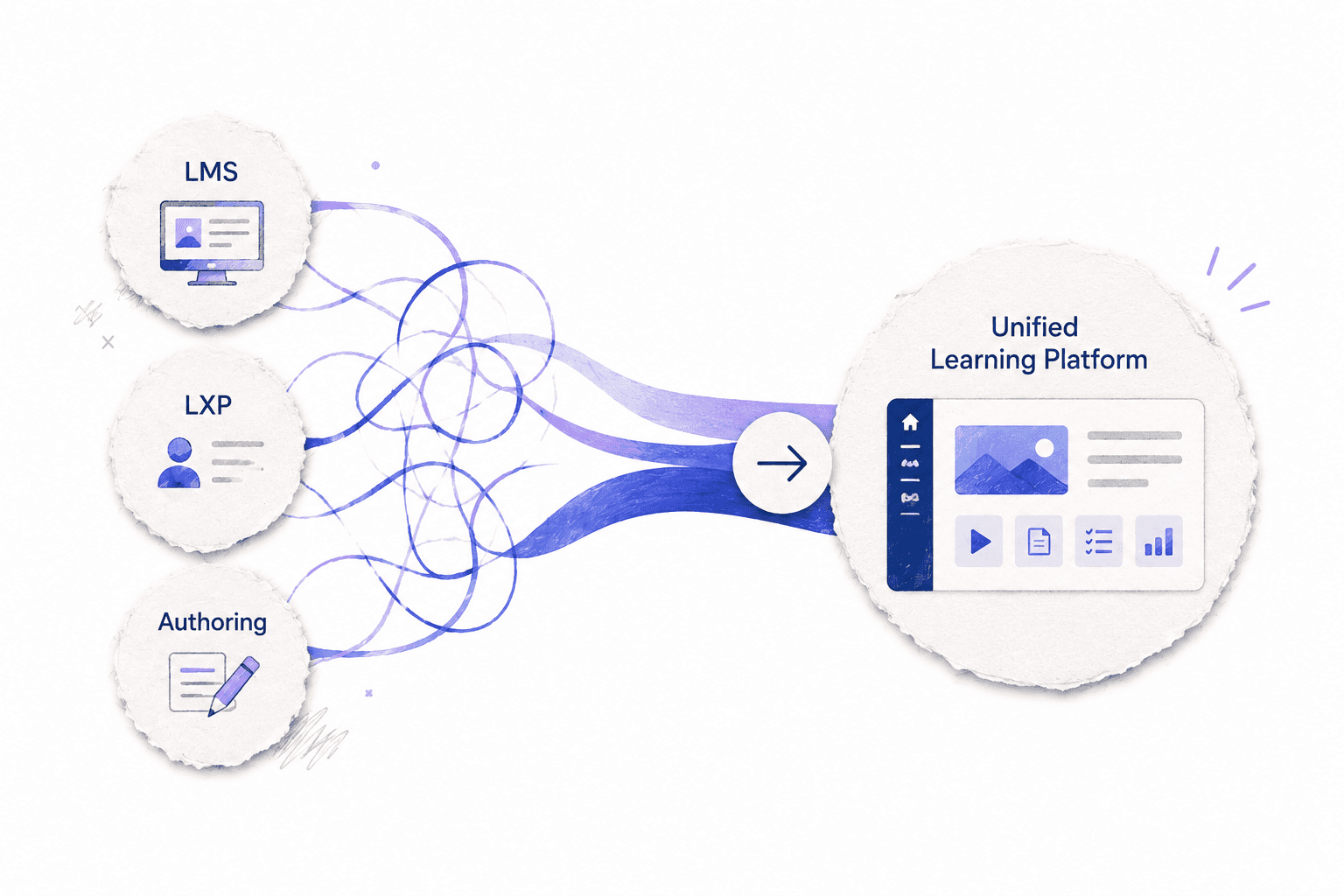
Sodium Learn was designed around a simple premise: the people using a learning platform admins, creators, and learners should never have to think about which tool they're in.
Instead of asking buyers to choose between an LMS, an LXP, and an authoring tool, Sodium replaces all three with one unified platform built for compliance-driven, distributed teams.
Here's what that looks like in practice:
Create: build and update learning content in one place, without a separate authoring tool or worrying about version conflicts
Manage: assign training, automate enrolments, and track compliance without spreadsheets or manual chasing
Learn: give learners a single place to find what's relevant, complete it, and prove it happened
Track: get one report that reflects reality, not three dashboards that contradict each other
For L&D and People teams at UK SMBs running compliance training across distributed teams, this isn't a nice-to-have. It's the difference between knowing you're compliant and hoping you are.
Sodium's starting point is the one burning problem most teams already have: replace your compliance tracking spreadsheet, automate your admin, and hit completion targets without stitching together tools that were never designed to work together.
Shihab Alii
Co-Founder & Marketing at Sodium Learn
Shihab leads Marketing, Brand & Growth initiatives. He helps shape the company's positioning, communication, and audience engagement strategies, combining experience in digital marketing, customer experience, and research. With a degree in Biomedical Sciences and Optometry, Shihab brings a unique blend of healthcare, analytical, and people-focused expertise gained through roles across healthcare.
Latest posts
Discover other pieces of writing in our blog